igordanic September 6, 2024
by Igor Đanić
Fabian Perez is an Argentine-born artist known for his evocative and atmospheric paintings that capture the essence of passion, mystery, and romance. His works, often depicting scenes of nightlife, tango dancers, and intimate moments, are deeply rooted in a style that has come to be associated with the Neoemotionalism movement. This review will delve into Perez’s distinctive artistic approach and the broader Neoemotionalism movement, offering insights into how these elements come together to create a compelling narrative through art.
The Allure of Fabian Perez’s Paintings
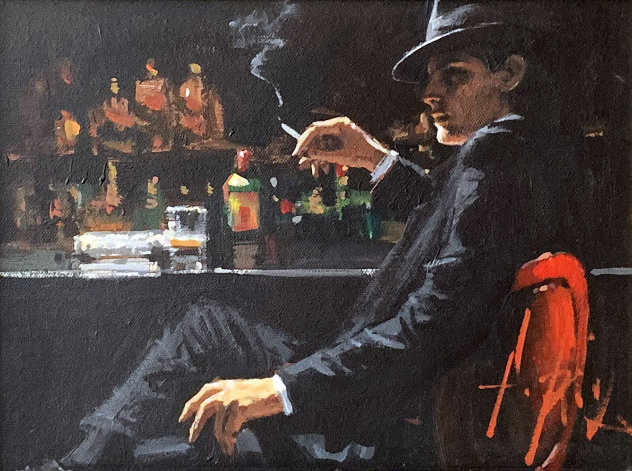
Fabian Perez’s paintings are immediately recognizable for their dramatic use of light and shadow, rich color palettes, and emotionally charged subjects. His work is often described as cinematic, with each painting resembling a scene from a classic film noir. The figures in his paintings—often solitary women, couples in passionate embrace, or men exuding a brooding intensity—are portrayed in moments of introspection, desire, or contemplation.
One of Perez’s most iconic works, Tango in Red (2007), exemplifies his mastery in capturing the intensity of human emotion. The painting features a couple lost in the fervor of a tango dance, their figures bathed in a warm, red glow. The man’s strong, commanding presence contrasts with the woman’s graceful, fluid movements, creating a dynamic tension that is both sensual and powerful. The use of light and shadow not only adds depth to the scene but also enhances the emotional impact, making the viewer feel as though they are witnessing an intimate moment frozen in time.
Interesting Fact: Fabian Perez draws much of his inspiration from his upbringing in Argentina, where he was exposed to the world of tango, nightlife, and the complex emotions that accompany these experiences. This personal connection to his subjects infuses his work with authenticity and passion.

The Neoemotionalism Movement
Neoemotionalism is a contemporary art movement that emerged in the late 20th and early 21st centuries as a response to the increasing abstraction and conceptualism in modern art. The movement seeks to return to the expression of raw human emotions, placing the artist’s emotional state and personal experiences at the forefront of their work. Neoemotionalism is characterized by a focus on the narrative and the exploration of the human condition, often through figurative and representational art.
Fabian Perez is often associated with Neoemotionalism because his work embodies the movement’s core principles. His paintings are not just about capturing a likeness or a scene; they are about conveying a mood, a feeling, or a story. The viewer is invited to connect with the emotions of the characters in his paintings, whether it’s the longing of a lone woman waiting by a window, the intensity of a couple locked in a dance, or the melancholy of a man lost in thought.
Interesting Fact: Neoemotionalism can be seen as a reaction to the detachment and impersonal nature of some contemporary art forms. Artists like Perez seek to re-establish a direct emotional connection with their audience, making art that resonates on a deeply personal level.
Techniques and Style
Perez’s technique is heavily influenced by the Old Masters, particularly in his use of chiaroscuro—the strong contrast between light and dark. This technique gives his paintings a dramatic, almost theatrical quality, drawing the viewer’s attention to the most emotionally charged elements of the scene. His brushwork is fluid and expressive, often leaving parts of the canvas loosely defined, which adds to the sense of movement and spontaneity in his work.
The color palette in Perez’s paintings is typically warm and rich, with deep reds, oranges, and browns dominating his compositions. These colors are not just aesthetic choices; they serve to heighten the emotional intensity of the scenes, evoking feelings of warmth, passion, and sometimes melancholy.
Interesting Fact: Perez often uses a limited color palette to maintain focus on the emotional content of the painting. By restricting his use of color, he directs the viewer’s attention to the interplay of light and shadow, and the emotions conveyed through the figures’ gestures and expressions.

The Impact and Legacy of Fabian Perez
Fabian Perez has garnered a significant following among collectors and art enthusiasts, particularly those who are drawn to art that evokes strong emotional responses. His work has been exhibited internationally, and his paintings are highly sought after for their ability to capture the complexity of human emotions in a visually striking way.
Perez’s influence extends beyond his own work, as he has helped to popularize the Neoemotionalism movement. His success demonstrates that there is a strong demand for art that prioritizes emotional expression and narrative depth, particularly in a world where art can often feel disconnected from the personal and the real.
Interesting Fact: In addition to his paintings, Fabian Perez has also authored books where he explores his artistic philosophy and the emotional motivations behind his work. These writings offer deeper insights into the mind of an artist who is committed to making the emotional core of his art accessible to a wide audience.
Conclusion: The Emotional Resonance of Fabian Perez and Neoemotionalism
Fabian Perez’s paintings are a powerful example of how contemporary art can connect with audiences on an emotional level. Through his mastery of light, color, and composition, Perez creates works that are not just visually stunning but also deeply moving. His association with the Neoemotionalism movement further underscores his commitment to art that speaks to the heart, capturing the complexities of the human experience in all its beauty and intensity.
For collectors and art lovers, Perez’s work offers more than just aesthetic pleasure; it provides a gateway into the world of Neoemotionalism, where art serves as a mirror to our deepest emotions and a testament to the enduring power of human connection.